Kazakhstan's Digital Landscape in 2026
Yandex has captured a third of Kazakhstan's search traffic from Google, TikTok now reaches nearly every adult internet user, and the battle for attention has shifted from getting people online to winning their time. Key takeaways from the Digital 2026 report.
Datareportal has published its Digital 2026 report on digital trends across countries, including Kazakhstan (based on data collected through the end of 2025).
A few findings worth paying attention to.
How Yandex Is Taking Search Share from Google in Kazakhstan
While the rest of the world debates whether AI search engines are chipping away at Google, Kazakhstan has its own storyline — and the challenger here is not ChatGPT but Yandex. In 2023, Google accounted for 89% of search-engine referral traffic, a near-monopoly. By 2025, that share had dropped to 64%, while Yandex climbed to 33.6%, capturing roughly a third of all search traffic in the country.
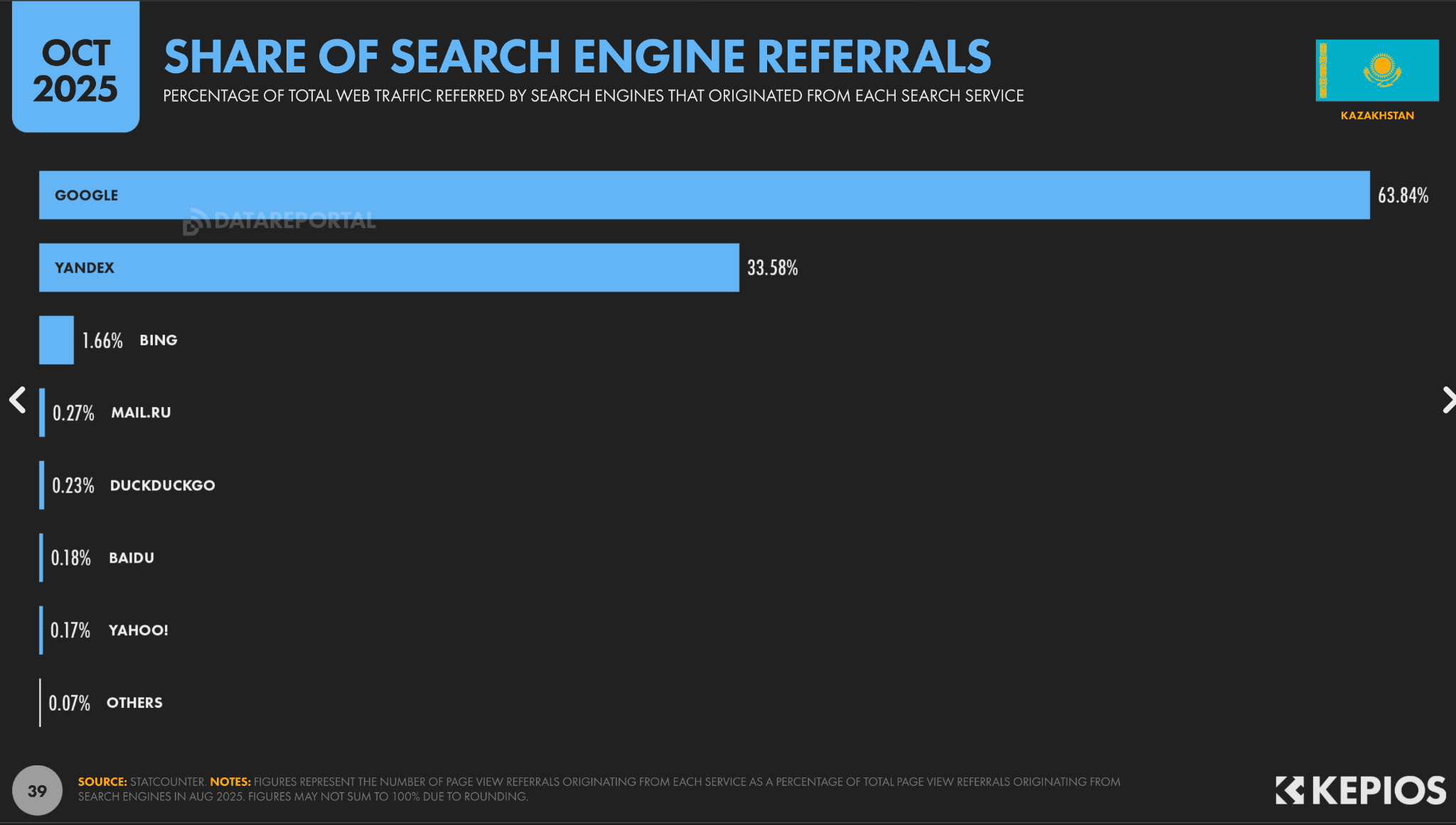
The decline was anything but gradual — Google lost 15 to 16 percentage points per year in both 2024 and 2025, after eight straight years of its share hovering between 70% and 89%. For context, every other player — Bing, Mail.ru, DuckDuckGo, Baidu, Yahoo — together accounts for less than 2.5%, so the redistribution is strictly a two-player affair.
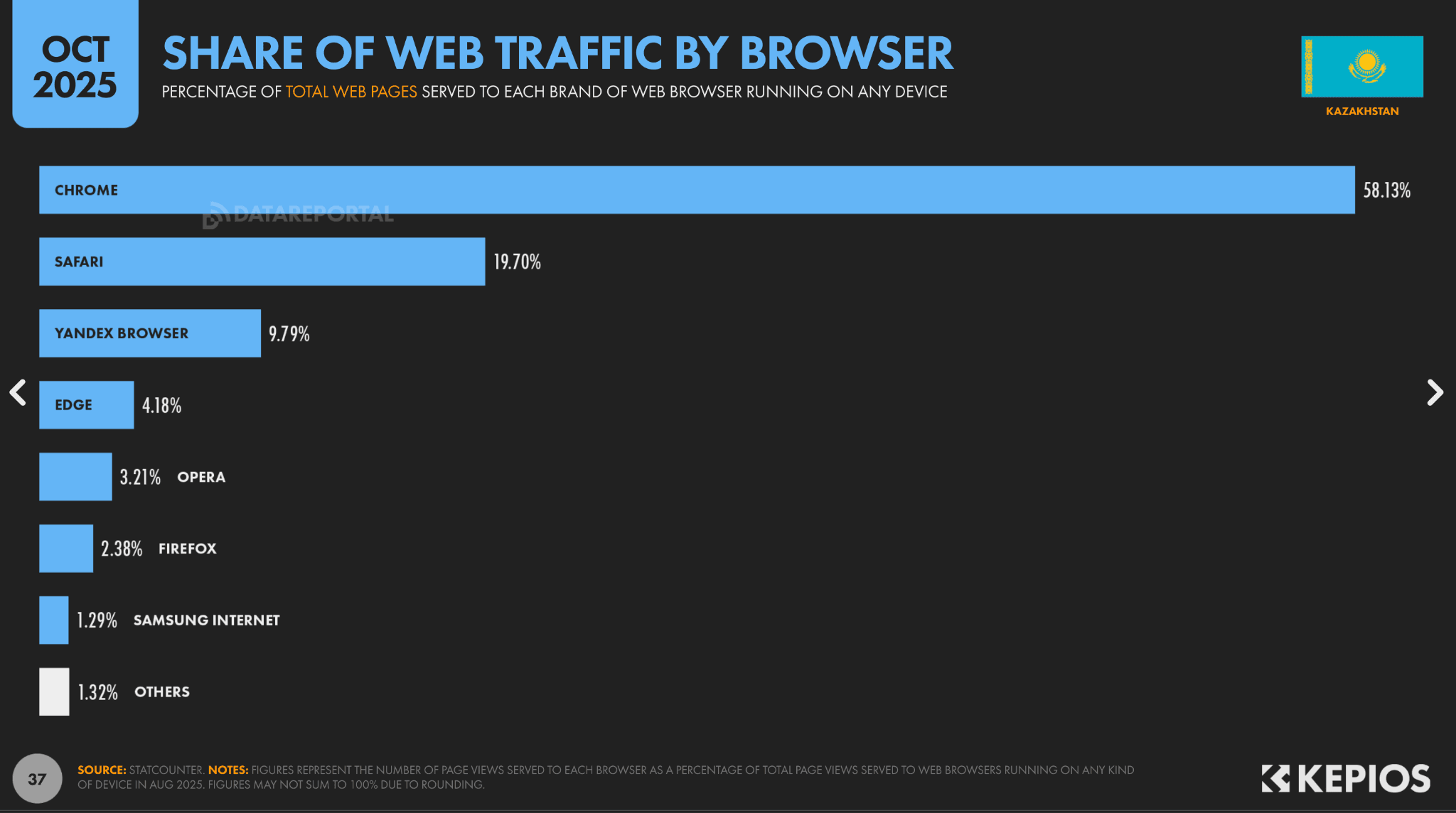
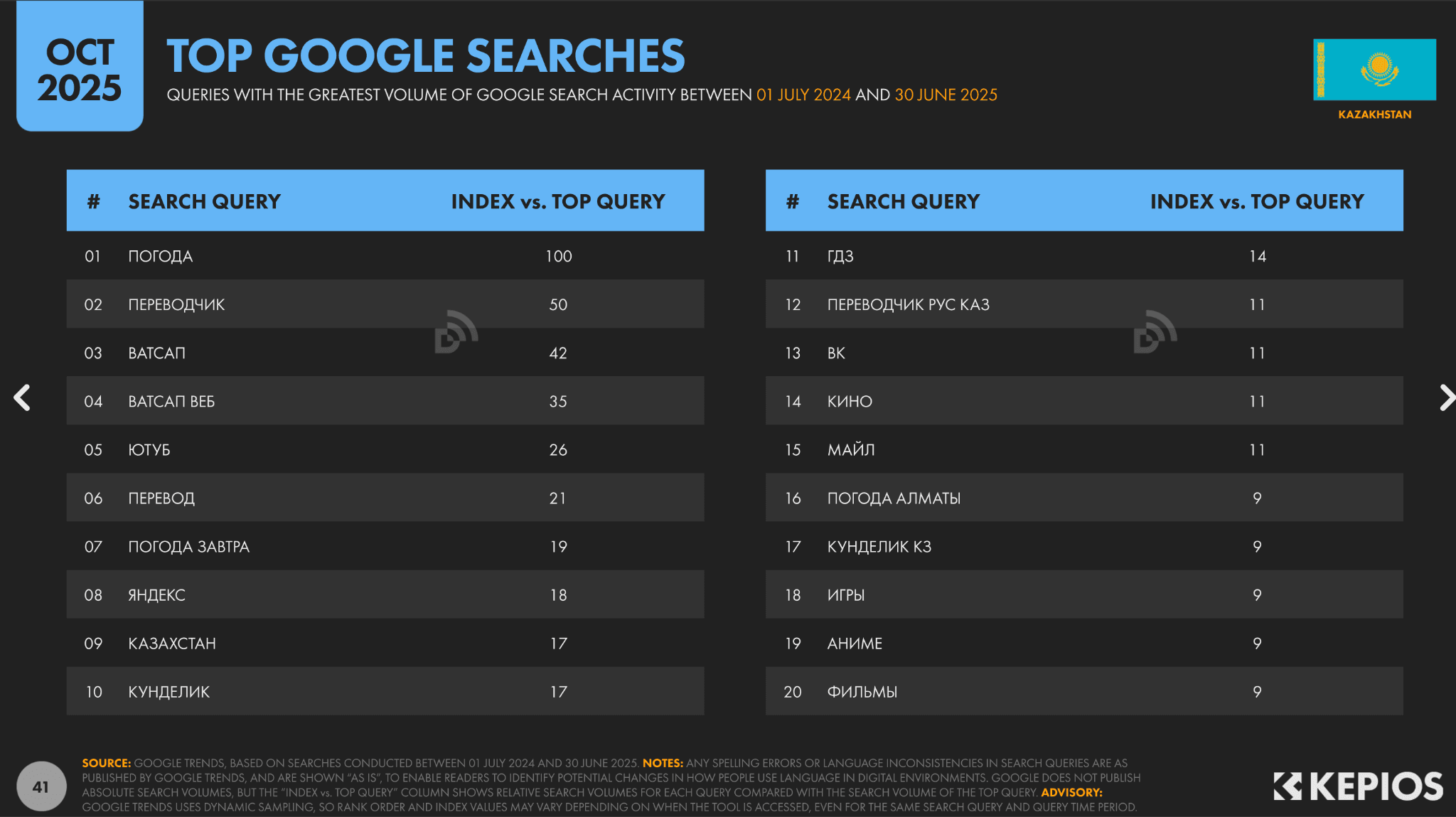
The browser landscape, though, tells a different story. Chrome holds 58.1% (after a brief dip the year before), Safari sits at 19.7%, and Yandex Browser trails in third at just 9.8% — nearly six times behind Chrome. So Kazakhstanis are increasingly searching via Yandex but not necessarily switching to its browser; they appear to treat Yandex as another service inside their usual Chrome or Safari. Top search queries back this up: "yandex" ranks among the ten most popular Google searches in Kazakhstan — users literally look up Yandex through Google, not the other way around.
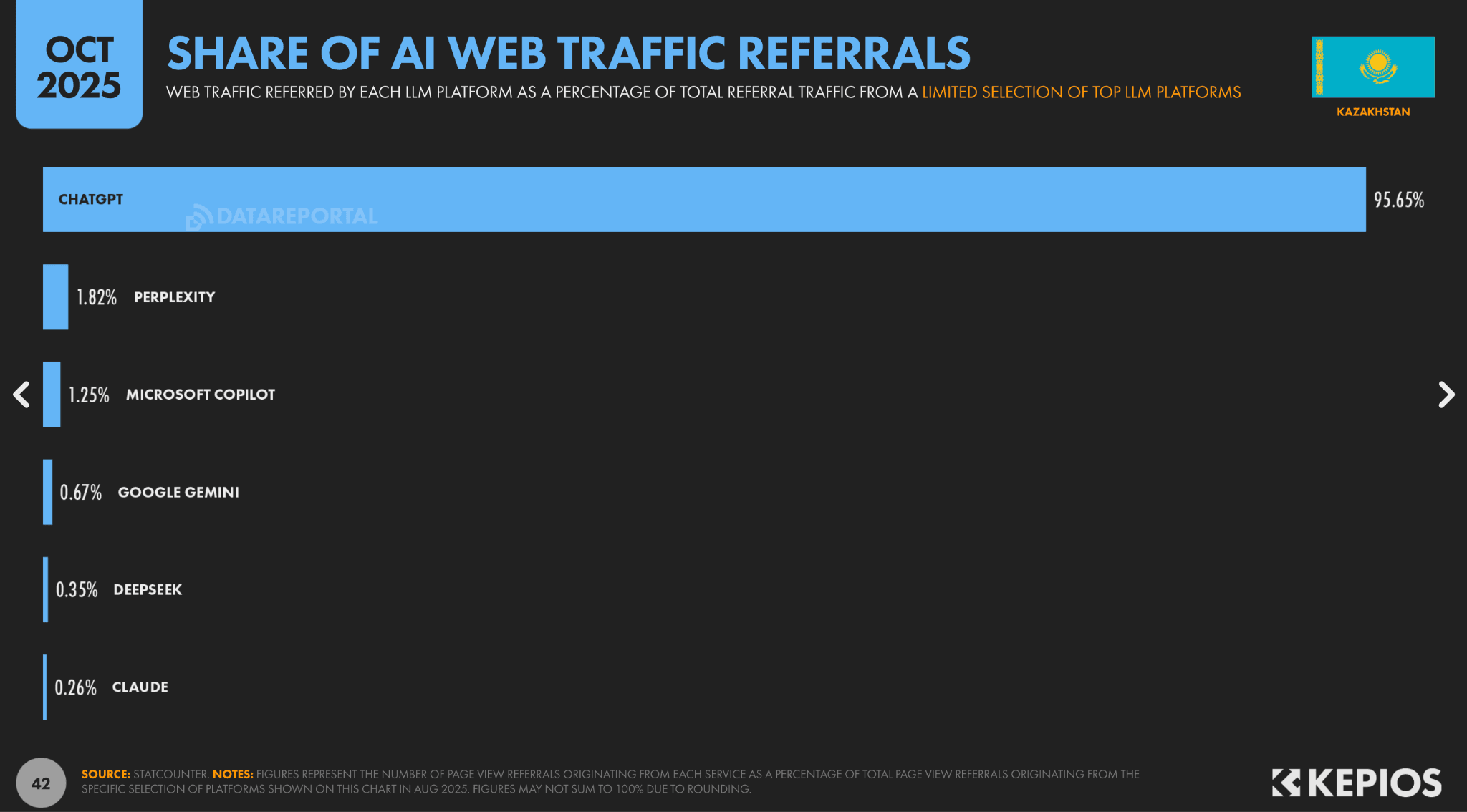
In AI-driven referral traffic, there is no competition to speak of. ChatGPT accounts for 95.65% of all website visits from AI platforms; Perplexity (1.82%), Microsoft Copilot (1.25%), Google Gemini (0.67%), DeepSeek (0.35%), and Claude (0.26%) together barely reach 4.5%. The asymmetry is hard to miss: in traditional search, Google has already ceded nearly half the market to Yandex, yet in the new AI-search space Google (via Gemini) has virtually no presence at all.
What this means for business and communications: relying on Google Ads and Google SEO alone now leaves a third of Kazakhstan's audience unreached. Companies serious about this market need a Yandex presence too — Yandex.Direct, Yandex.Maps, and placements across its news and media services.
The same applies to media work. When choosing outlets for placements, companies should check how a publication ranks not only on Google but also on Yandex: the same article can pull strong traffic from one search engine and almost none from the other. For any PR agency operating in Kazakhstan, factoring Yandex visibility into media planning is becoming a baseline requirement. Separately tracking what Perplexity, Gemini, or other AI platforms know about your brand is hardly worth the effort yet — their combined referral share is too small to move the needle on reach.
Internet and Social Media Keep Growing — but Unevenly
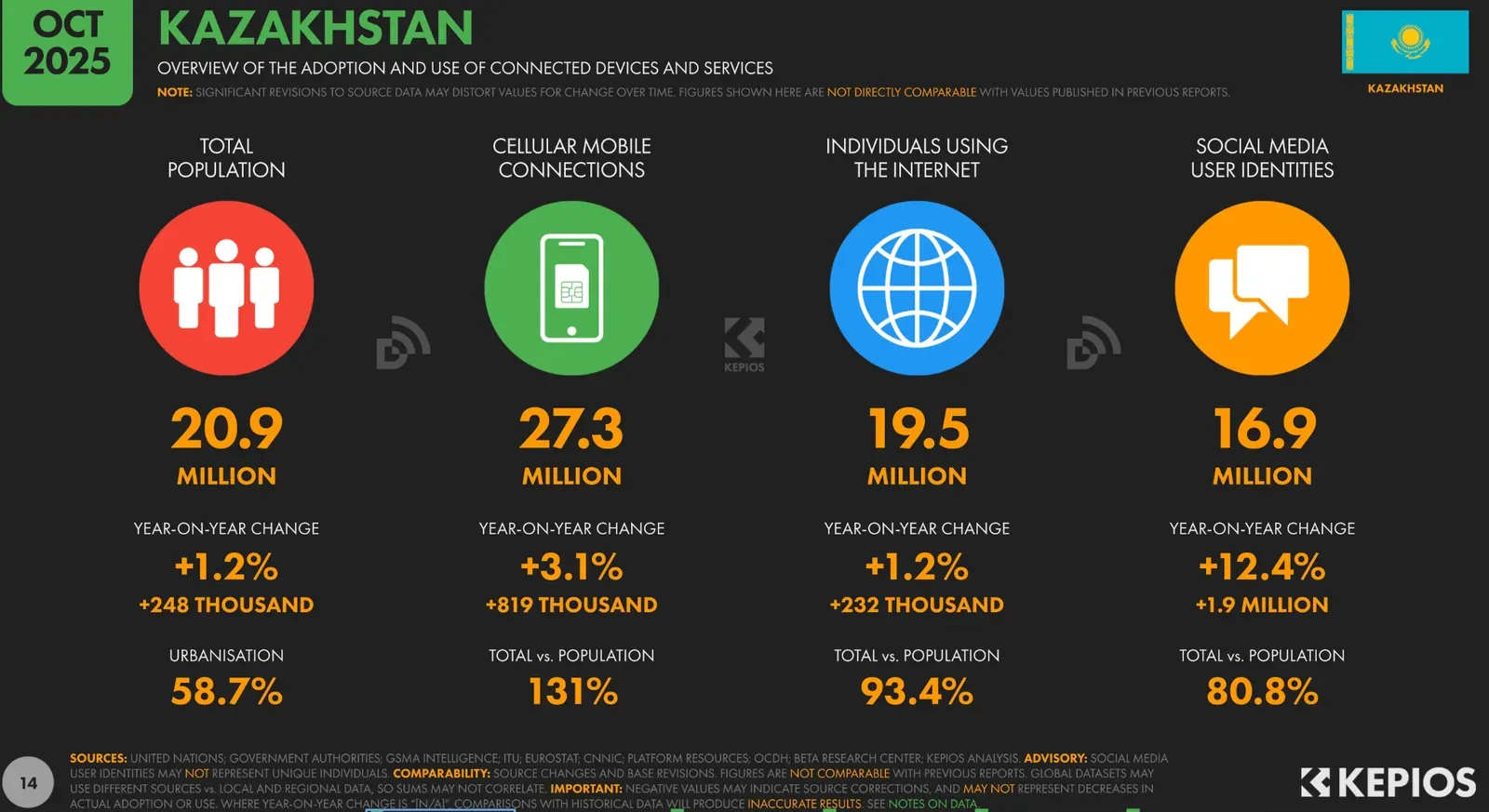
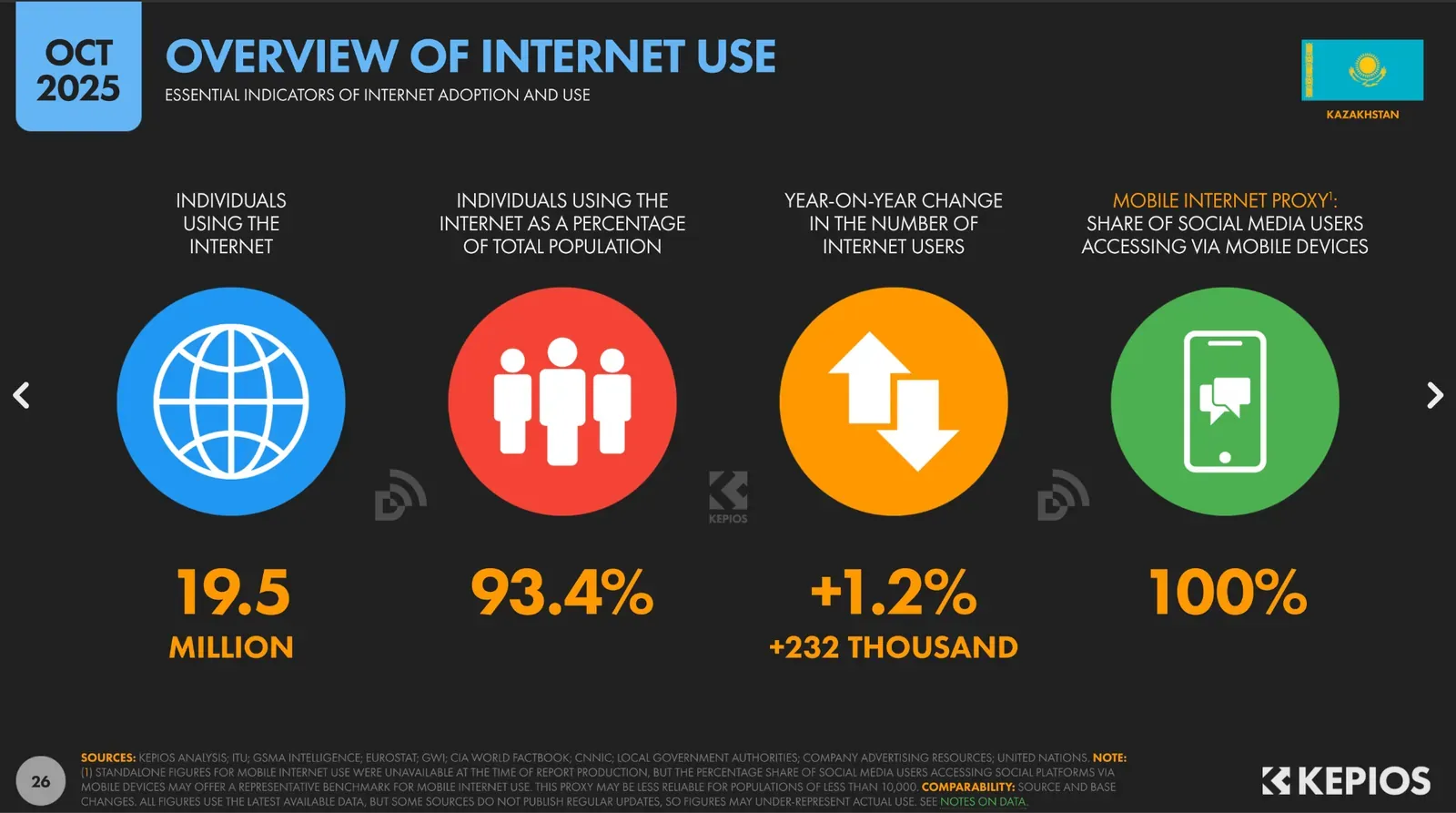
Internet penetration is close to its ceiling — 93.4% of the population (19.5 million people), with only token growth: 232,000 new users over the past year, leaving the penetration rate unchanged on paper. Social media, however, is moving faster: 16.9 million users (80.8% of the population), up 1.9 million year over year (+12.4%). The main driver of digital growth in Kazakhstan is no longer first-time internet access but existing users adopting more platforms and services.
Mobile connections outnumber people — 27.3 million, or 131% of the population — pointing to widespread use of multiple devices and/or SIM cards and eSIMs per person.
Within social media, a redistribution similar to search is underway: some platforms are surging while others are losing ground.
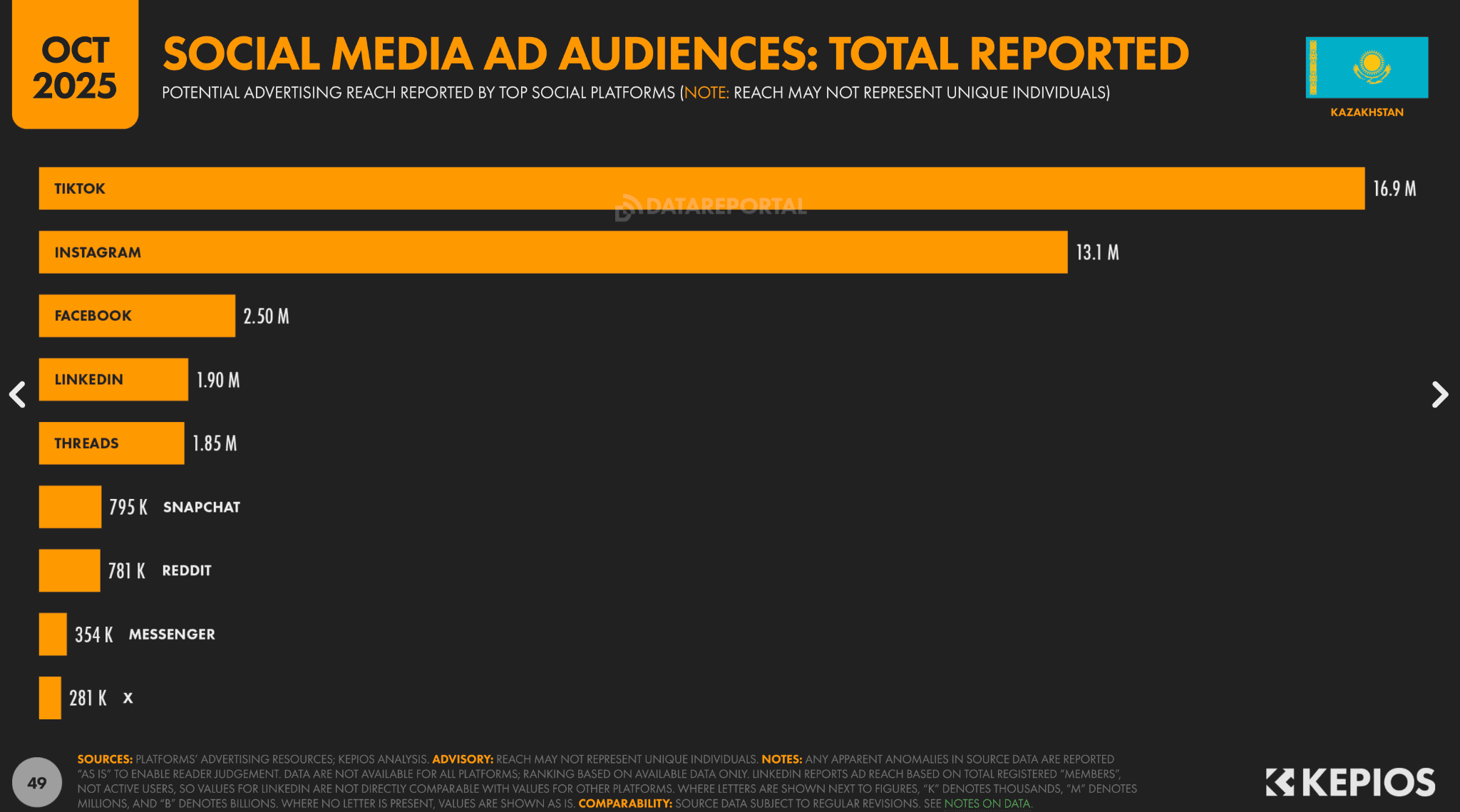
- TikTok is the year's biggest gainer: +1.86 million users (+12.4%). The platform now reaches virtually every adult internet user in the country.
- Instagram is also up: +1.15 million users (+9.6%), with total reach of 13.1 million.
- LinkedIn posted the fastest relative growth: +18.8% (+300,000), though in absolute terms it remains niche (1.9 million).
- Reddit grew +527% year over year, but in absolute terms the platform is still small (781,000 users) — more curiosity than mass trend.
- Facebook and Messenger declined — by 3.8% and 8.1% respectively. DataReportal cautions that such drops are often driven by platforms purging inactive and fake accounts rather than by a real exodus of active users, so writing off Facebook is premature.
Note: in 2026, DataReportal changed its methodology for calculating social media audiences and Meta advertising metrics, so this year's figures are not always directly comparable with the 2024 reports — some apparent growth or decline may reflect recalculations and data cleanup on the platforms' side rather than actual shifts in user behavior.
Takeaway: Kazakhstan's internet audience has essentially stopped expanding — nearly everyone who can go online already has. Competition now centres on the time and attention of existing users: TikTok vs. Instagram for video, Google vs. Yandex for search. For brands, this means growth through reaching the "not yet connected" no longer works. The fight is for share of attention in a saturated market.
More data in the Digital 2026: Kazakhstan report.
https://datareportal.com/reports/digital-2026-kazakhstan?utm_source=chatgpt.com
The report on Uzbekistan's digital landscape can be viewed here.
Translated with an AI translator