Uzbekistan: Google still leads search, but ChatGPT owns AI traffic
ChatGPT already captures 95.4% of AI-driven referral traffic in Uzbekistan, Google's search share is slipping, and Instagram accounts for nearly all social media growth. The key data points from Digital 2026.
Datareportal has published its Digital 2026 report covering digital trends across countries, including Uzbekistan (data collected as of late 2025).
A few findings worth flagging.
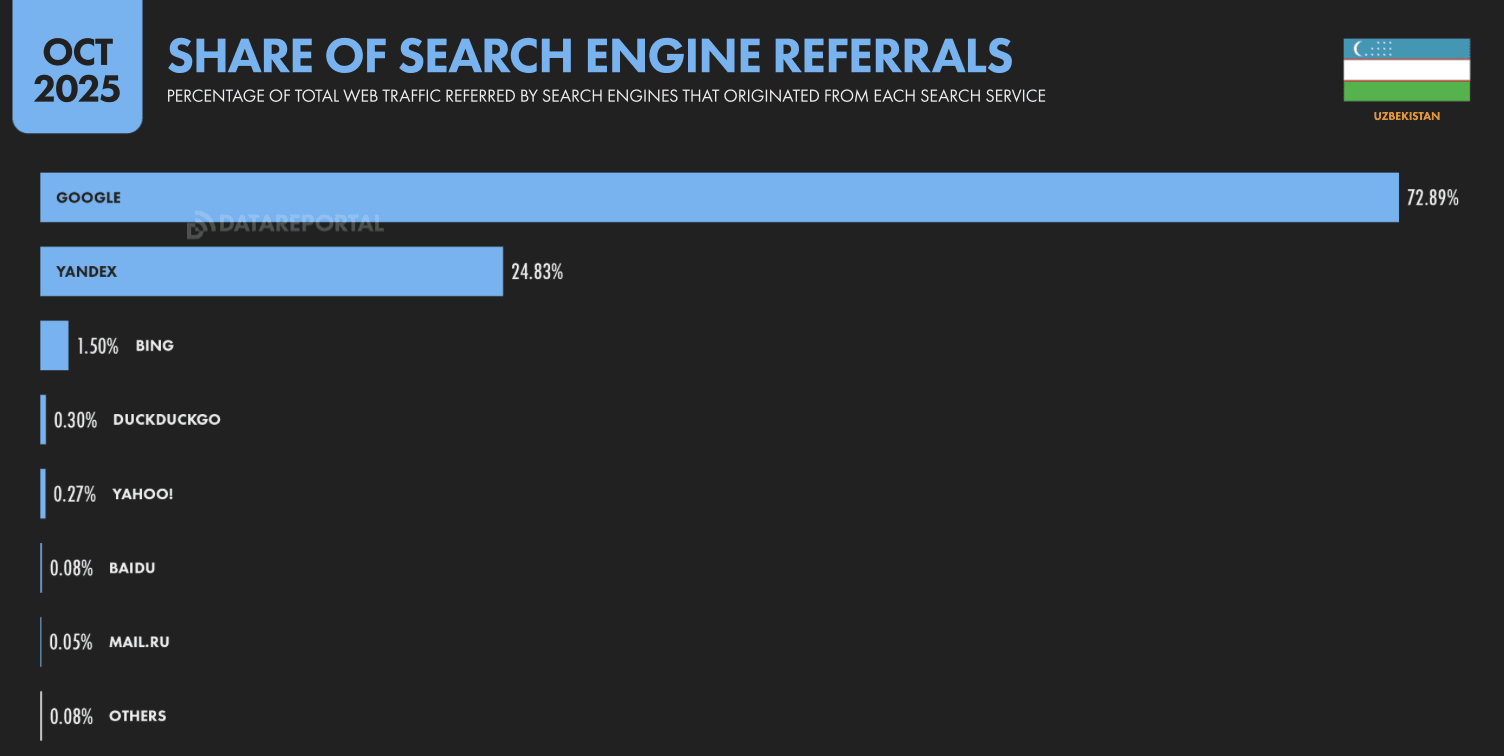
The global AI chatbot race is still playing out, but in Uzbekistan the result is already in: ChatGPT accounts for 95.4% of all website referrals from AI platforms. Perplexity, Microsoft Copilot, Google Gemini, Claude and DeepSeek split the remaining 4.6%. Traditional search looks more familiar — Google holds 72.9%, Yandex 24.8% — but a year ago Google's share was 5.9 percentage points higher.
Google is holding on, but the trend is clear
No revolution in traditional search yet: Google retains 72.9% of referral traffic, Yandex 24.8%. Year-over-year, though, Google dropped from 78.8% in 2024 to 72.9% in 2025 (−7.5%), while Yandex kept climbing. The direction is hard to miss.
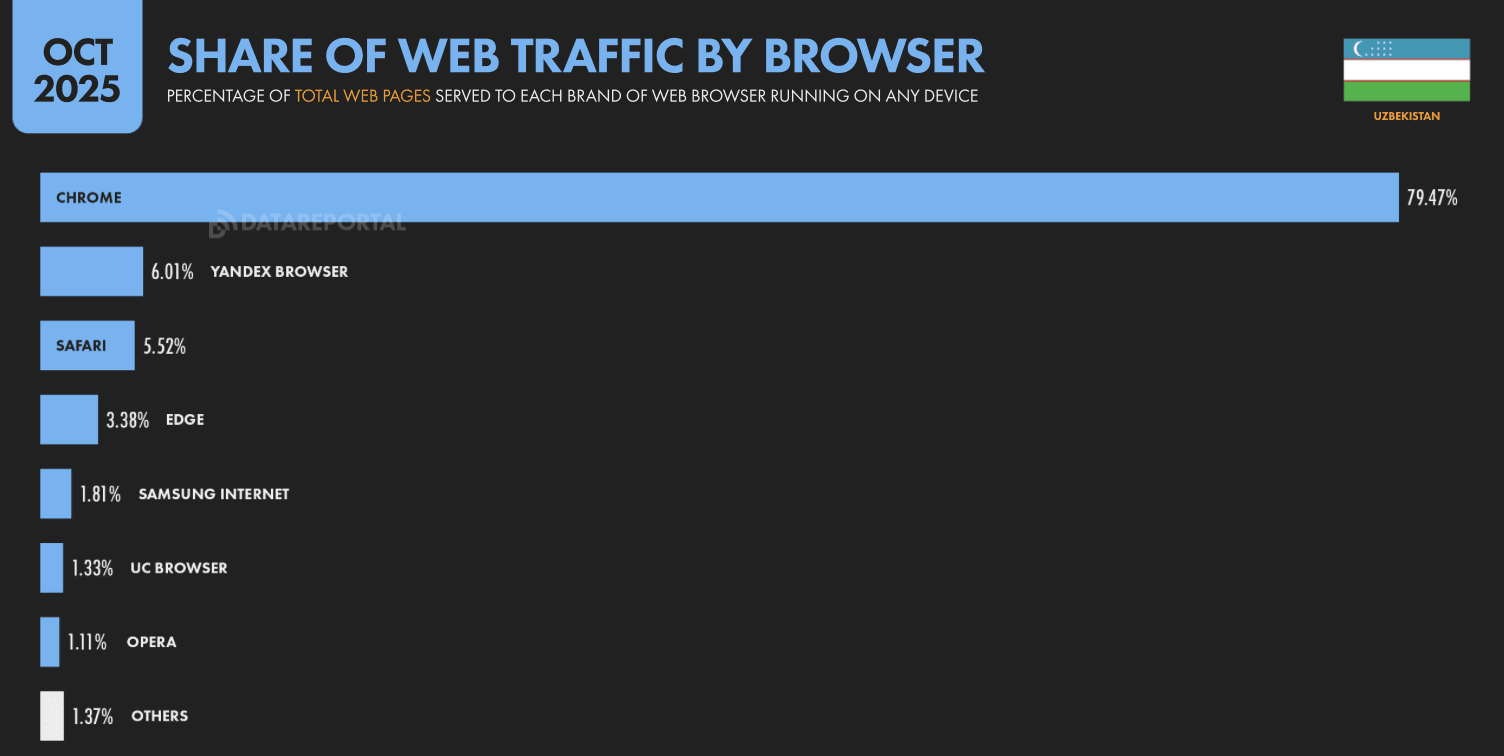
At the browser level, Google looks more secure: Chrome's share is growing — from 73.8% to 79.5% over the year (+7.7%) — while Yandex Browser sits at just 6%. People are searching through Yandex more often, but doing so inside Chrome rather than Yandex's own browser.
What businesses need to factor in
This shift matters for media planning too. When choosing outlets for earned or owned publications, evaluating Google visibility alone is no longer enough — Yandex rankings deserve equal attention. The same piece of content can pull very different organic traffic depending on the search engine serving it.
Monitoring how your brand shows up in Perplexity, Gemini or other AI search tools is not a priority yet: nearly all AI-driven referral traffic in Uzbekistan flows through ChatGPT, and the combined share of everything else is too small to move the needle.
A uniquely Uzbek story: a school platform tops search queries
The biggest surprise in Uzbekistan's top search queries is not a social network or an AI tool — it is a school gradebook. The query «kundalik» (the national electronic gradebook platform) ranks third overall and eighth in the standalone top, beating Instagram and YouTube on certain metrics. It is a striking case of government digitalisation of a single service — electronic record-keeping for schools — generating a visible share of an entire country's search traffic.
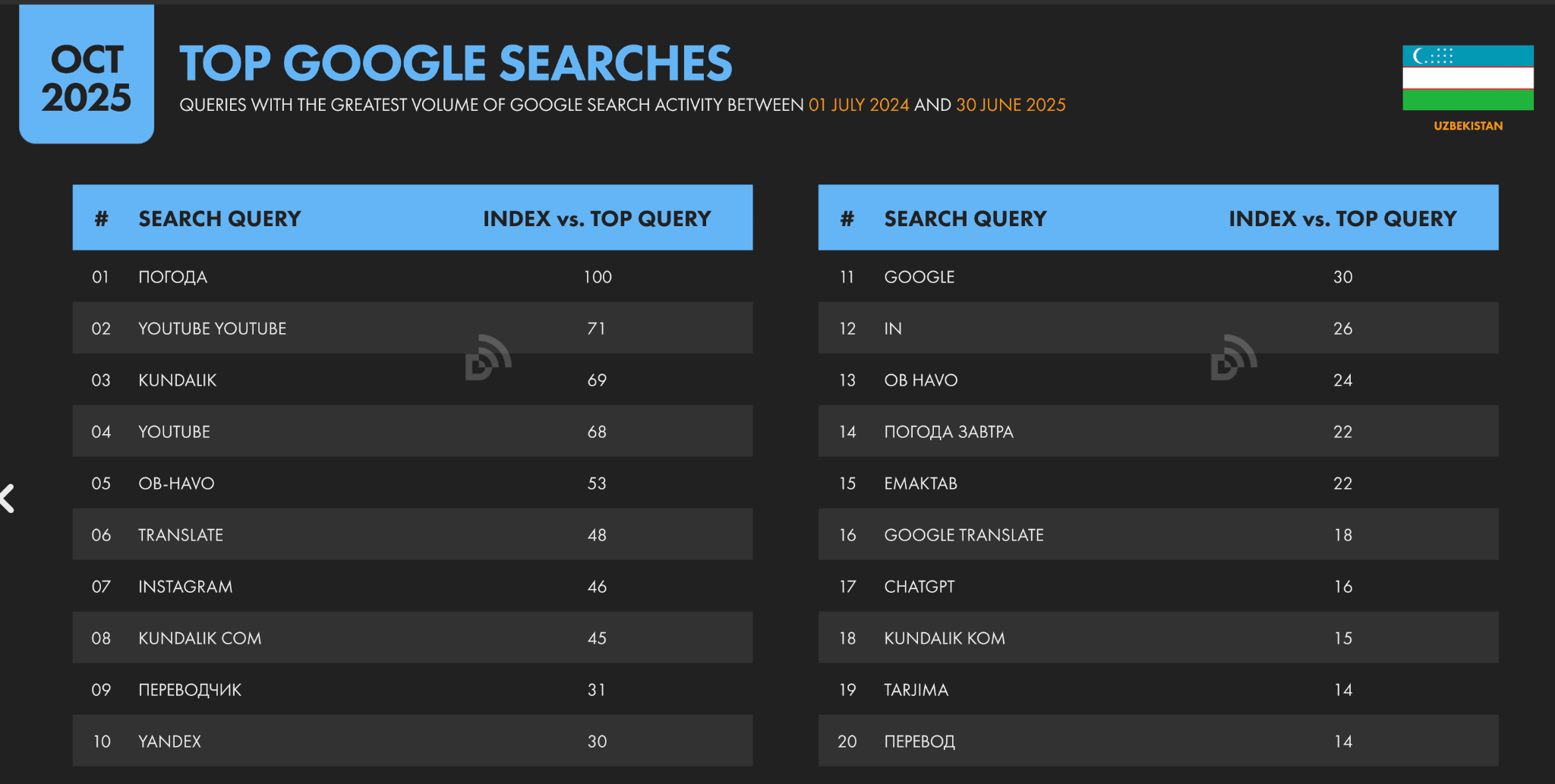
For context, «yandex» and «google» as search queries also sit in the top 20 — a good number of users search for one engine through the other rather than navigating to it directly.
Internet penetration has plateaued; iOS is slowly gaining share
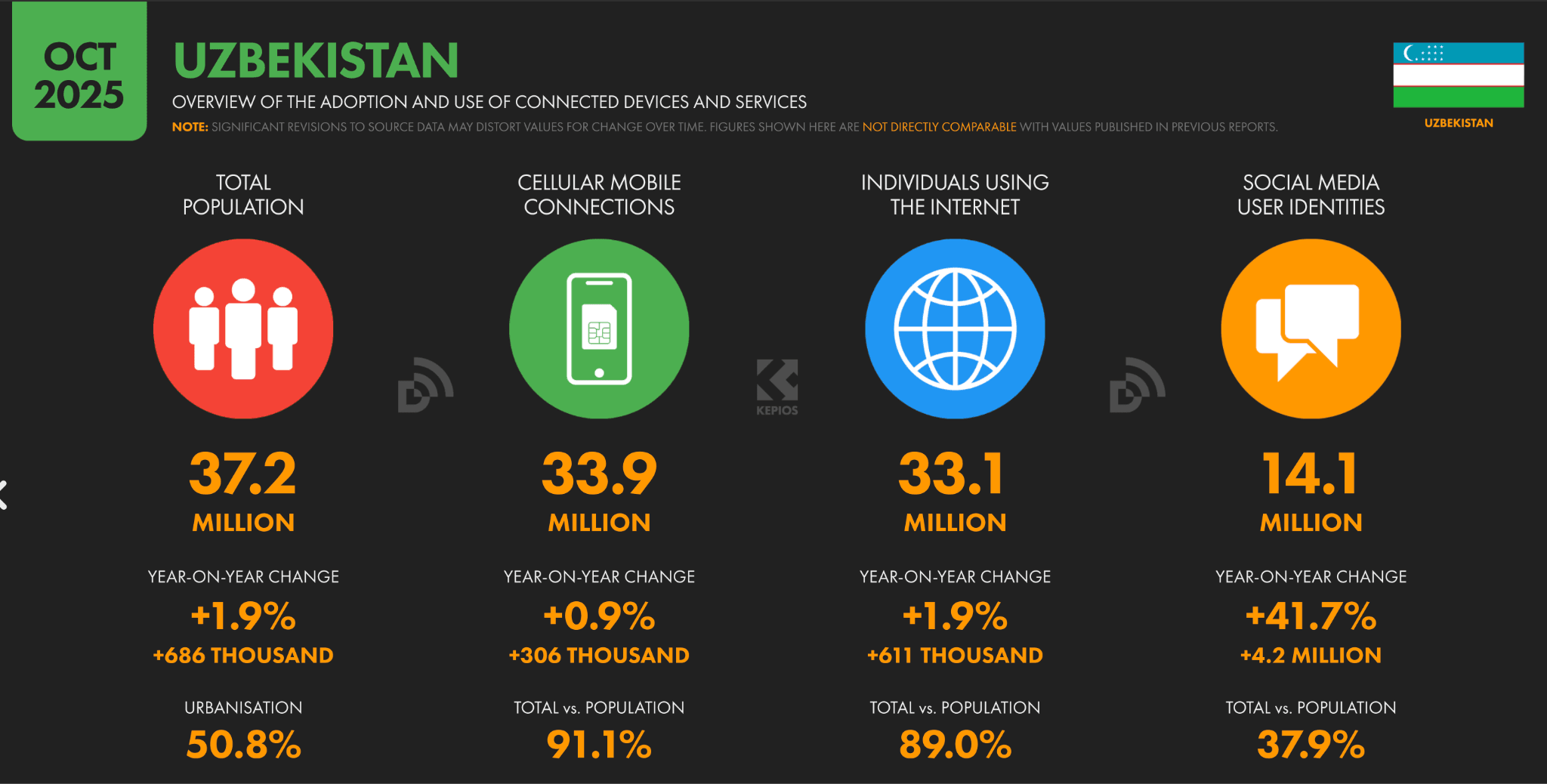
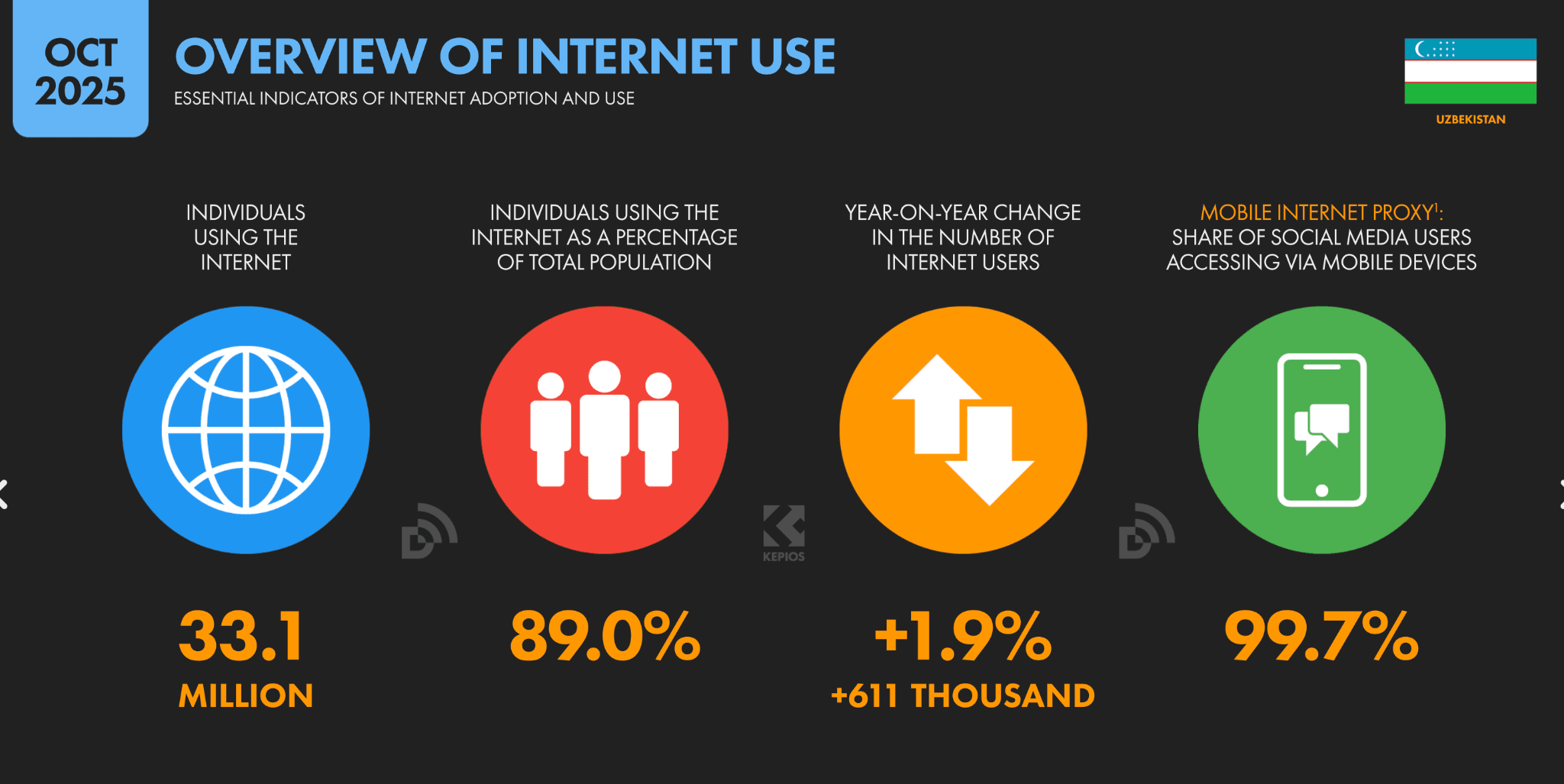
Internet penetration in Uzbekistan has sat at 89.0% for three straight years (2023–2025). The absolute user count is still rising (33.1 million, +611 thousand year-over-year), but the growth comes from population increase, not new people coming online. The market is saturated: from here, growth will be measured in time and money spent by existing audiences, not in new connections.
Android still dominates mobile web traffic at 83.8% versus 16.0% for iOS, but a quiet shift is visible: Android's share has fallen for five consecutive years, from a peak of 91.0% in 2020 to 83.8% today. iPhone is gaining ground, slowly but consistently.
The country has 33.9 million mobile connections — 91.1% of the population.
Social media: rapid growth driven by a single platform
Social media in Uzbekistan grew sharply over the past year: +4.2 million users (+41.7%), bringing the total audience to 14.1 million (37.9% of the population).
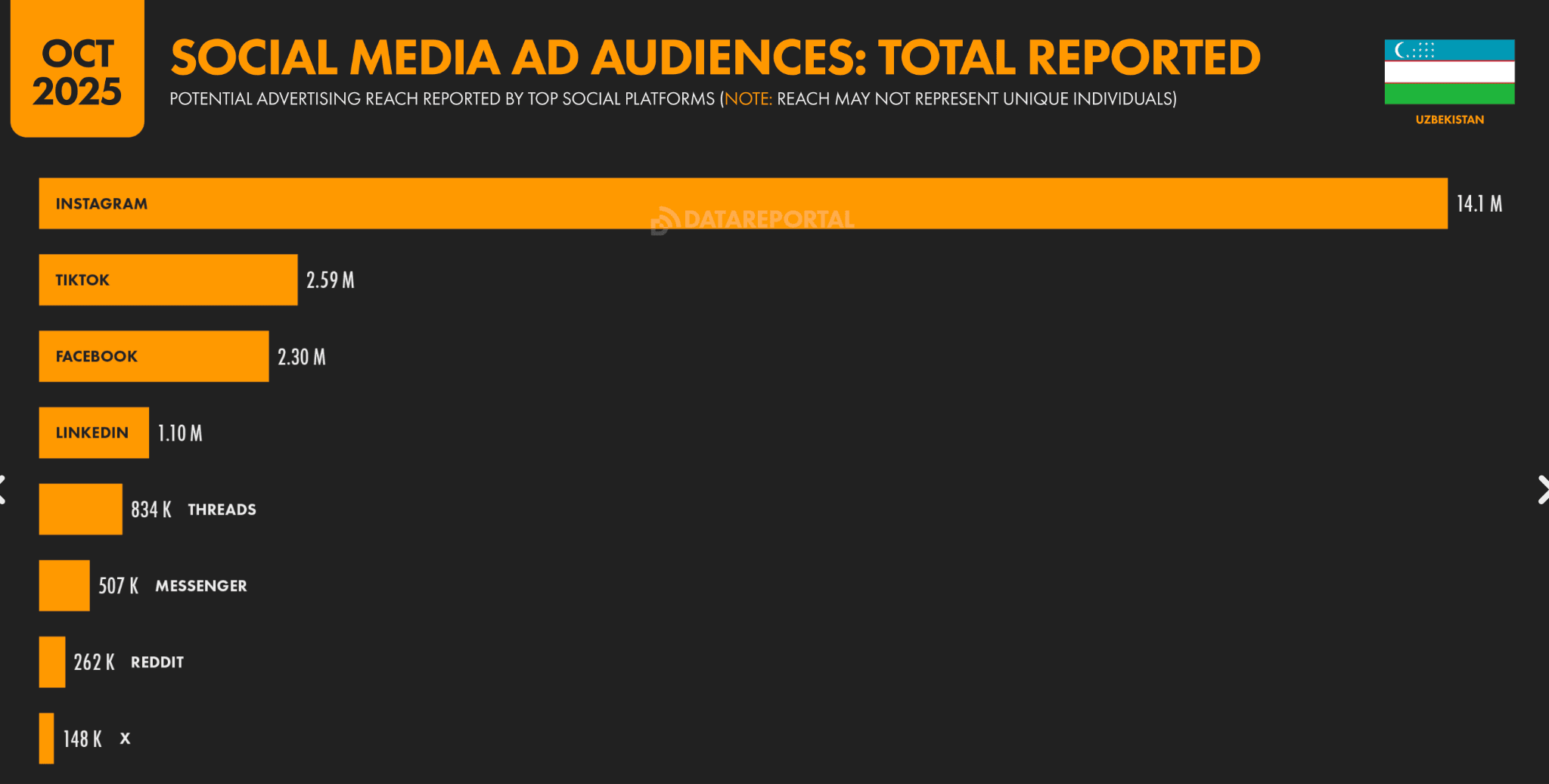
- Instagram drove nearly all of that growth: +4.15 million users (+41.7%). The platform now reaches 14.1 million people — virtually every social media user in Uzbekistan.
- LinkedIn kept pace in percentage terms: +39.2% (+310 thousand), though the absolute base is 1.1 million.
- TikTok grew far more modestly — 3.2% (+80.5 thousand), reaching 2.59 million adult users.
- Facebook and Messenger were flat: Facebook +2.2% (+50 thousand), Messenger added just 200 users.
- X (Twitter) lost nearly two-thirds of its audience: −60.3% (−224 thousand) over the year, the steepest decline of any platform in the country.
Note: in 2026 DataReportal changed its methodology for calculating social media audiences and Meta advertising reach, so this year's figures are not always directly comparable with 2024 data. Some of the apparent growth or decline may reflect recalculation and data cleanup on the platforms' side rather than real shifts in user behaviour.
Takeaway: social media growth in Uzbekistan rests on one platform — Instagram, which already reaches nearly every active social user in the country. For brands that is both opportunity and concentration risk: you can cover almost the entire audience through a single channel, but dependence on one platform's policies becomes a serious vulnerability.
What this means for business: Uzbekistan's search market is not yet split as sharply between Google and Yandex as some neighbouring countries, but Yandex's upward trend is already in motion, and AI traffic has been decided — in favour of one player. Companies shaping their digital strategy for 2026–2027 should start building a presence in ChatGPT-oriented formats now — optimising content for LLM-based search, not just traditional SEO — rather than waiting for Yandex's share to climb further. For companies entering Central Asian markets, working with a PR agency experienced in Uzbekistan can help calibrate these search and platform dynamics from the outset.
More data in the full report Digital 2026: Uzbekistan: https://datareportal.com/reports/digital-2026-uzbekistan
For an overview of Kazakhstan's digital landscape, see this article.
Translated with an AI translator